
:Faye’s question on..picking puppies
Posted: February 2, 2008 Filed under: Apso Aficionados, Lotsa Lhasa Info 1 CommentA few days ago, Faye sent photos of her latest litter, asking what priorities to place on puppies at this age.
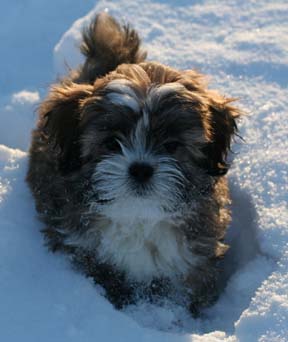
Here’s the link to more photos and the pedigree.
How old are they, Faye? It appears they’re old enough to be ‘standing up over themselves’. Assuming they are, my evaluation would be done mostly with observation. If they aren’t yet ‘standing up over themselves’, I simply enjoy watching puppies play.
I note the movement on each puppy, including carriage, confidence and attitude. It’s hard to put into words what I look at. It’s the entire picture, the entire dog, based on my own knowledge of anatomy and the breed. I note the parts, how the parts fit together and how each puppy uses itself. I note the balance on each puppy, taking into consideration length of leg and length of body. I note rear angulation, particularly in the stifle. I don’t select on length of hock, but I do note it. Longer hocked puppies will move closer – wobblier possibly – going away than their shorter hocked siblings. This is important to remember as they grow. Rear angulation in our lineage is..well, it is. Our dogs usually have exceptionally nice rear angulation. It’s one of the things that give the FFT dogs ground-covering movement. I’m probably biased, but I do think, generally speaking our dogs’ rear assemblies propel them above many others. Pun intended. Rears with big angles and long bones need muscles, mature muscles, conditioned muscles for peak performance.
Those rears need a front assembly that can keep up the pace. Julie can comment better on what she actually looks at and feels for while the puppy is in a stack. I judge it all watching the puppy. I look for freedom in the forward reach of the front legs. Does that reach balance with the rear drive? I look to see how the front end is coming at me, mainly noting if the puppy is wide coming at you. You can see it all, if you’re patient, have a nice block of time for observation and a tasty beverage. Well, I mean you can see the balance if it’s there. If it’s not there you won’t see it. Unless you’ve had too many tasty beverages of the adult kind. My point is..you must catch the movement at some point during puppy play, between the wild dashing and leaping of exuberant puppies. You’re certainly not going to catch it if you put a lead on the puppy and try to gait it!
Prior to this age, from birth actually, I have been watching head type. As I look at the entire litter, I already know which head/s I prefer. I’ve found that heads – at least the heads I’m used to working with – rarely change. A pretty head remains a pretty head. And, if you’re lucky, there’s a pretty head on the most balanced puppy!
None of the above really answers your question about priorities. If I’ve done a particular breeding for a particular feature, then I will look for that feature and weigh it more heavily than usual when selecting my pick puppy. For example, if I bred my lovely, Shih-Tzu head-style dog to another lovely dog with an excellent typey head, if I did the breeding based on ‘head’ alone (and I have), I’d select a puppy with a longer, narrower head. Or if there’s a particular feature I’d rather move away from, again I will give more ‘weight’ to the puppy that doesn’t exhibit that feature. For example, if one parent were…missing an upper incisor…my selection could very well be influenced by which puppy had a complete set of upper incisors. It’s very possible the puppy I selected for such reasons wouldn’t be ‘pick of the litter’. But the weight of all factors, with a bit of extra weight on the wanted or unwanted feature, changes my choice for ‘pick of litter’. Again, it’s a balance thing.
A skilled breeder will balance the purpose of a particular breeding when evaluating a litter. The best overall puppy may not be the one the breeder will keep. If you’re lucky it is!
Now, if I were picking a Gompa puppy…forget all the above! I’ll take the one with a beating heart! 🙂
Julie on..sharing
Posted: February 2, 2008 Filed under: Apso Aficionados, FFT Lhasa Apsos | Tags: Julie Timbers 1 Comment 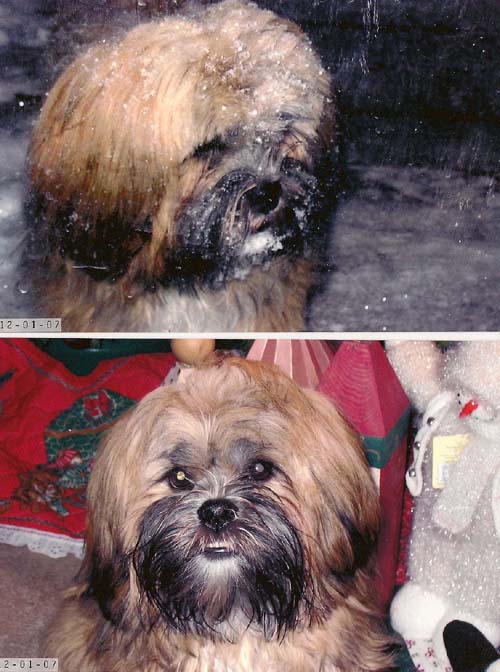
This is Dana, owned by Paul and Patricia. She is a littermate to Anna
and went to live in her “forever” home December’04. Paul and Patricia’s daughter
adopted a dog (Edie’s littermate) from me in ’06, also.
Blind Dogs See With Their Hearts
Posted: February 2, 2008 Filed under: Apso Aficionados 4 CommentsIn one of her comments, Susan mentioned a care package…
“Aw shucks, Kathy R, you really shouldn’t have, but it was so very nice of you and …. I’m glad you did. Folks, today my postlady brought me a care package from Kathy with just all sorts of wonderful goodies for “Old Blind Dog” and the rest of us. I was/am so touched by her thoughtfulness !!!! ”
Zap! Susan, zap! You’ve been touched! One never knows what Kathy will come up with next. It’s always a surprise. It’s always fun. It’s always thoughtful. To commemorate Panchen and his odyssey, Kathy gave me this card…
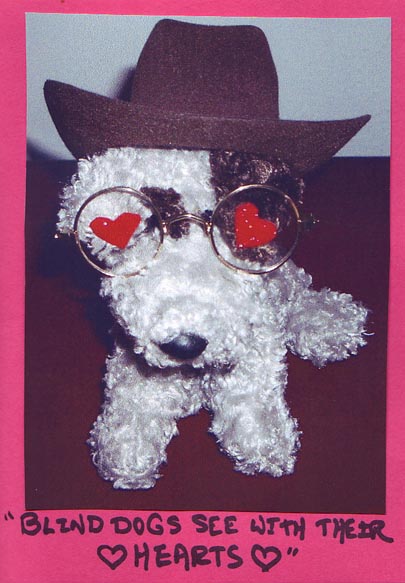
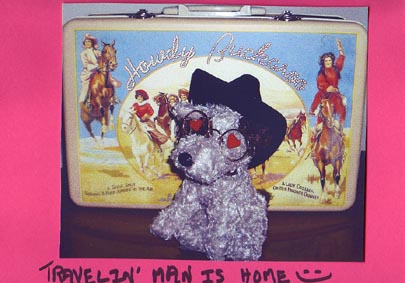
I’m not sure if Kathy used the ‘suitcase’ as a backdrop for this photo or if it was actually part of the care package she sent you and your crew. If so, maybe you could put that old collar and lead Panchen was wearing when he arrived in Colorado in it. I know it’s probably useless, but somehow…I thought the worldly possessions he arrived here with needed to be with him in his new home.
Vickie’s..rescue blog
Posted: January 28, 2008 Filed under: Apso Aficionados 2 CommentsVickie has set up a blog for her rescue work. I’ve added it to the links under :Apso Aficionados. Take a look.
Katy on…Sadie’s Yeast Infection
Posted: January 24, 2008 Filed under: Apso Aficionados 2 Commentsor..How we overcame Malassezia Pachydermatitis starts:
When Sadie first came to us in early November 2007, we noticed that she was “itchy” but attributed it to her move from humid Minnesota to very dry New Mexico. I bathed her with “dry skin” shampoo and conditioner, but the itching continued.
By December 21, I noticed that the fringes of her ear leathers were encrusted with yellowish, flake-like scabs that came off when I scratched them, but did not bleed like a true scab covering a wound. She was, by this time, scratching her ear leathers and ear canals furiously. She was also biting her toenails and licking her feet..
Katy, thank you so much for taking the time to write this informative article, complete with photos. About a year ago, in an attempt to help Eli, my husband’s Labrador Retriever with his incessant scratching, I educated myself just a bit about yeast after reading about it in Whole Dog Journal. Here’s what I wrote on the Veterinary page of the website as that time:
One suggestion is that an overgrowth of yeast in the intestines eventually leads to gut leakage. The body identifies these toxins and mounts an attack, which manifests as ‘allergies’. Treatment for ‘allergies’ may provide temporary relief; what is needed for total relief is to decrease the yeast population with the use of diet.
While I haven’t been nearly as diligent with the diet as you, Eli’s diet is largely made up of a raw meat. Yeast – at least yeast in the intestinal tract – feed on carbohydrates, so the approach is to not provide the yeast colonies with carbs. And…I admit to using an anti-histamine to help during particularly bad times.
While still with Julie, Sadie along with several other dogs went through several sessions of ‘itching’. I am wondering now if yeast was the actual culprit. Perhaps Julie will fill in the details… Although skin scrapings showed no irregularities, Julie treated her dogs with Ivermectin (which has the added benefit in mosquito country of preventing heartworms). The itching subsided and we jokingly named the entire episode “The Mutant Mites”. Couldn’t see mites upon microscopic examination, but the response to treatment was positive. The obvious question is would yeast respond to Ivermectin?
I groom a little Scottish Terrier, Wally, every two weeks. He is the nicest little dog, but lives in constant misery. He has been to a skin specialist, has had numerous tests to determine what he’s allergic to, is on a kibble diet that doesn’t contain any of those ingredients. It hasn’t made any difference. Yesterday I asked his owner if he’s been tested for yeast. Yes! She said, “sometimes he has it. Sometimes he doesn’t.” She’s at her wit’s end.
So, what comes first? The yeast or the allergies? The chicken or the egg?
 Kunza at FleetFire Timbers