
Sometimes there is a light at the end of the tunnel.
Posted: December 9, 2007 Filed under: Lotsa Lhasa Info Leave a comment
Canine rabies challenge studies have begun!
Posted: December 2, 2007 Filed under: Lotsa Lhasa Info 1 CommentGreetings! The Rabies Challenge Fund is pleased to announce that the canine rabies challenge studies have begun!!! Permission is granted to post and cross-post the text of our press release below. Regards, Kris L. ChristineFounder, Co-TrusteeThe Rabies Challenge Fund http://www.RabiesChallengeFund.org CANINE RABIES CHALLENGE STUDIES BEGIN ! One of the most important vaccine research studies in veterinary medicine is underway at the University of Wisconsin School of Veterinary Medicine in Madison. Dr. Ronald Schultz, a leading authority on veterinary vaccines and Chair of the Department of Pathobiological Sciences, has begun concurrent 5 and 7 year challenge studies to determine the long-term duration of immunity of the canine rabies vaccine, with the goal of extending the state-mandated interval for boosters. These will be the first long-term challenge studies on the canine rabies vaccine to be published in the United States. Dr. Schultz comments that: “We are all very excited to start this study that will hopefully demonstrate that rabies vaccines can provide a minimum of 7 years of immunity.” This research is being financed by The Rabies Challenge Fund, a charitable trust founded by pet vaccine disclosure advocate Kris L. Christine of Maine, who serves as Co-Trustee with world-renowned veterinary research scientist and practicing clinician, Dr. W. Jean Dodds of Hemopet in California. The Rabies Challenge Fund recently met its goal of $177,000 to fund the studies’ first year budget with contributions from dog owners, canine groups, trainers, veterinarians, and small businesses. Annual budget goals of $150,000 for the studies must be met in the future. Dr. Jean Dodds, DVM states: “This is the first time in my 43 years of involvement in veterinary issues that what started as a grass-roots effort to change an outmoded regulation affecting animals will be addressed scientifically by an acknowledged expert to benefit all canines in the future.” Scientific data published in 1992 by Michel Aubert and his research team demonstrated that dogs were immune to a rabies challenge 5 years after vaccination, while Dr. Schultz’s serological studies documented antibody titer counts at levels known to confer immunity to rabies 7 years post-vaccination. This data strongly suggests that state laws requiring annual or triennial rabies boosters for dogs are redundant. Because the rabies vaccine is the most potent of the veterinary vaccines and associated with significant adverse reactions, it should not be given more often than is necessary to maintain immunity. Adverse reactions such autoimmune diseases affecting the thyroid, joints, blood, eyes, skin, kidney, liver, bowel and central nervous system; anaphylactic shock; aggression; seizures; epilepsy; and fibrosarcomas at injection sites are linked to rabies vaccinations. Study co-trustee Kris Christine adds: “Because the USDA does not require vaccine manufacturers to provide long-term duration of immunity studies documenting maximum effectiveness when licensing their products, concerned dog owners have contributed the money to fund this research themselves. We want to ensure that rabies immunization laws are based upon independent, long-term scientific data.” More information and regular updates on The Rabies Challenge Fund and the concurrent 5 and 7 year challenge studies it is financing can be found at the fund’s website designed by volunteer Andrea Brin at: www.RabiesChallengeFund.org.
A Good Dog
Posted: November 23, 2007 Filed under: Lotsa Lhasa Info 1 Comment
I spent a good portion of today doing ‘mindless’ entries on the web site. A pile, a tall pile, has been sitting near my computer, waiting to be shared for months upon months. Stuff. All kinds of stuff. Interesting stuff. Heartwarming stuff. Informational stuff. Stuff I want to share. Stuff I want to catalog for future use. It’s not mindless stuff. It’s important – at least to me – stuff. The ‘mindless’ part simply describes what it takes to get it on the web site. No creativity involved. Simple data entry, so to speak. I did’t feel creative today, so data entry it was.
You’ll be able to find some of the stuff, some of the articles if you peruse the web site looking for new stuff. This, however, needs to be brought to your attention. This book. This book about A Good Dog. A Good Dog owned by Jon Katz. I loved this book. I devoured this book. Not being able to find words to describe this book, I’m stealing the words of a reviewer: “ A Good Dog is a book to savor. Just as Orson was the author’s lifetime dog, his story is a lifetime treasure–poignant, timeless, and powerful.”
It’s a book about commitment. It’s a book about love. It’s a book about being able to make the right choice, an extremely difficult choice. It’s a true story. Read it and weep.
Picky, picky
Posted: November 23, 2007 Filed under: Lotsa Lhasa Info 4 Comments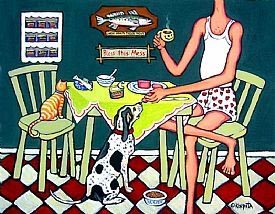
Jack’s Cat Would Eat No Trout
His Dog Would Eat No Spam
by Rebecca Stringer Korpita
Alma brings up the issue of picky eating habits: “I just ordered some Ground tripe and liver treats from absolute K-9. Roadie is getting picky again. He will eat if I am sitting there. He eats a little and goes back off and on to eat.”
Alma, please describe how you prepare Roadie’s meal, as well as the exact contents and his mealtime ritual. Do you feed him once or twice a day? How often, how many and under what circumstances does he get treats.? Knowing the answers may help me give you more specific advice.
Each dog is an individual, but in my experience picky eaters are usually created by concerned dog owners. A dog isn’t going to starve itself or go hungry, unless it is very sick. My feeding routine is used to monitor each dog’s daily well-being and doesn’t allow picky eaters. I feed a mixture of kibble, raw meat and ‘dog grog’, as Ginny calls it. Dog grog consists of leftovers, fresh vegetables, maybe a seasoning or three. Each morning I put a soup kettle on the stove – go Deb go; see Debby cook. 🙂 I start by putting in enough water to adequately moisten the kibble, adding the other available ingredients and heating up the concoction. The dog grog that’s cooking right now contains fresh carrots, fresh potatoes, a turkey carcass, leftover rice and pepper. I will toss that into the kibble, add raw meat and mix thoroughly. I wait a few minutes before feeding, allowing the kibble to soak up the dog grog. Each dog is presented with a bowl of food. Any food not eaten is picked up in five minutes. That is the key, so let me repeat…any food not eaten in five minutes is picked up. I say nothing to the dog. There are no second chances. The dog waits until the next morning when, once again, breakfast is served. No big to-do, no pleading, no comment. The food simply goes away.
On occasion, I have a dog that doesn’t dive in and gobble my tasty preparation. (One reason I like to cook for dogs is they all think I’m a GREAT cook! I can fool the dogs every time with my finesse in the kitchen!) I make a mental note and if the dog doesn’t eat the following morning, I know something is wrong. In my situation, the feeding ritual is extremely important for monitoring each dog’s health.
Puppies, of course, are feed more than once a day. Thateus and Wyatt (Sadie’s puppies) eat breakfast along with every one else. Up until last week, they ate a second meal in the late afternoon. Now, kibble is available to them throughout the day and taken away in the late afternoon.
The keys to overcoming an picky eater, I think, are to offer the food for five minutes and make sure the food is interesting. Dry kibble just doesn’t cut it!
But Doc, the Dog’s Already Dead
Posted: November 12, 2007 Filed under: Lotsa Lhasa Info 6 Comments
Over the weekend, a friend shared this excellent, excellent article with me. Having been responsible for the health and well-being for numbers of dogs since I was a young teen-ager (Mom owned a boarding kennel and caring for the large dog building was my chore…meanwhile my sister Lori’s chore was cooking…hummm – enough of nature vs. nurture!), along with working at a small animal veterinary clinic in high school and graduating post-high school with a degree in Veterinary Technology, I have witnessed the transition in veterinary medicine. This author’s words are right on! And, I could elaborate regarding the experiences of my grooming clients. Because of my own knowledge I wouldn’t allow the veterinarian to try to revive my dead dog, but I can tell you plenty of my clients would. I have wondered, in the past few years, what happened to the option of euthanasia with pets. Veterinarians seem not to present the option. Rather, my clients will bring up the subject with me, as if seeking approval for something they’ve been thinking about. Off the top of my head, I can recall client dogs that tried to die, tried to die at the time their body seemed programed to leave this earthly world. Over and over, intervention prevented this from happening. My heart goes out to these dogs. I’ve even told a dog or three that if he/she wanted to die, go ahead and do it right here, at my grooming shop. I’ll hold you. I’ll be with you. And I won’t call in the ambulance. Now, I’ve never had a dog take me up on that…and I’d probably contact the owner, but, hey, why not give the old dog a fantasy!
I find it very disturbing that insurance companies have become involved in veterinary medicine. Isn’t it interesting what a mess our health care system is in, and now we, as consumers, have opened that door for veterinary medicine. And, isn’t it interesting that many of us have made a living will, expressed our desire not to have heroic methods taken to prolong our lives. Some of us would like to see euthanasia as an option for humans. Yet, that final gift, that legal gift, the gift of release from an aged, diseased body, is being used less and less on our animals.
I have been searching for a new veterinarian. David, my former vet, I really really like. He is skilled. He is competent. He learned to do kidney biopsies for me. He’s a good man. But, his prices have become unreasonable. So high, in fact, several months ago I wondered if I’d be able to continue breeding dogs! The last health certificate I got there cost me nearly $250!! Tests were ran on the dog’s eyes (and, no this wasn’t Panchen) without my permission. The final straw was an entirely new staff.
So, Edie and I headed off to an old-school vet for the health certificate she needed to fly to Houston for the National. I had done plenty of research trying to find a compatible veterinarian. My criteria is somewhat different than the average owner. It’s a pain-in-the-behind to establish a new relationship with a new vet and staff. I knew I had made the right decision when he told me, unsolicited, that he didn’t like the way veterinary medicine is headed!
 Kunza at FleetFire Timbers
