
:Uprising with 2008 Olympics as a platform begins…
Posted: March 15, 2008 Filed under: Lotsa Lhasa Info 2 CommentsBy Jill Drew
Washington Post Foreign Service
Friday, March 14, 2008; 7:58 AM
BEIJING, March 14 — A week of tense confrontations over Chinese rule in Tibet erupted in violence Friday, as hundreds of protesters clashed with police and set fire to shops in the center of Lhasa. Doctors reported dozens of wounded streaming into area hospitals and one witness said the downtown area was “in a state of siege.”
The rare breakout of violence, the worst in 20 years in the capital city of a remote mountainous region that is the heart of Tibetan Buddhism, posed a challenge to the Chinese government as it prepares to host the 2008 Olympic games in August. Seeking to make the games a worldwide celebration of its swift economic progress over the past three decades, the Chinese government has steadfastly attempted to project an image of harmony and stability, even while tightening its grip over the restive region.
“This spiraling unrest has triggered the scenario the Chinese prayed would not happen,” said Robbie Barnett, director of modern Tibetan studies at Columbia University. “Now we’re just watching the clock tick until people get off the street or the Chinese open fire.”
The U.S. Embassy in Beijing, citing “first-hand reports from American citizens in the city who report gunfire and other indications of violence,” issued an advisory warning tourists to avoid Lhasa. A doctor said in a telephone interview that he received 41 wounded at the Tibetan Autonomous Region People’s Hospital in Lhasa. An official at the People’s Hospital of Lhasa said there were many wounded, but gave no details.
A person who answered the phone at a Lhasa firehouse confirmed “many places are on fire,” but said there were “too many” to be specific.
The protests began Monday, when a few Buddhist monks and nuns demonstrated in a public plaza to commemorate Tibet’s 1959 failed uprising against China. Hundreds of monks from a nearby monastery marched to join them, but were stopped by police, who arrested between 50 and 60 of them, according to news reports. Hundreds more monks took to the streets on Tuesday to demand the release of those arrested, and were reportedly dispersed with tear gas. By Wednesday, police and paramilitary officials had surrounded at least two monasteries and the monks could not leave, witnesses said. By Thursday, the roads to the three main monasteries in the mountains near Lhasa were blocked and reports emerged that two monks had attempted suicide and others were staging hunger strikes.
Early Friday morning, there were reports of armed personnel carriers stationed on the road to the monasteries. Fu Jun, a spokesman for the local Chinese government, said in a telephone interview that the situation had “stabilized.”
But at 11 a.m., monks from a small monastery in the heart of Lhasa attempted to start a demonstration, the Times of London reported. As police attempted to break it up, hundreds of Tibetans stepped in and the fighting began.
As evening came, bars and restaurants in the city center closed down. “We want to stay inside,” said one bar manager in a telephone interview. “It’s safer.”
The Chinese government had no immediate comment on the violence, but had previously blamed the violence on the Dalai Lama, Tibetan Buddhist’s spiritual leader, who fled to exile in India after the 1959 uprising. “This is a political scheme by the Dalai group, attempting to separate China and try to make some unrest in the normal harmonious, peaceful life of Tibetan people,” Chinese foreign ministry spokesman Qin Gang told reporters on Thursday.
Sonam Dagpo, secretary of information and international relations for the Dalai Lama’s organization in Dharamshala, said that was not the case. “The Dalai Lama has always advised events to be peaceful,” he said in an interview on Friday morning. “His holiness did not ask anyone to protest.”
Meanwhile, in India, a group of 100 Tibetan exiles who had pledged to march back to Tibet to call attention to their demands for religious freedom and Tibetan independence from China, were sentenced to 14 days in detention by a local magistrate after being stopped by police on Thursday near Dehra. They had walked about two hours from their starting point in Dharamshala.
“We are totally focused and committed right now to the march and our effort right now is to secure the release of the marchers,” said Tsewang Rinzin, president of the Tibetan Youth Congress, in a telephone interview. “We know what is going on. We can see that India appears to be cozying up to China at all costs, and that is a disappointment.”
Rama Lakshmi contributed to this report.
:Physical therapy for dogs prone to luxating patellas
Posted: March 11, 2008 Filed under: Lotsa Lhasa Info 2 CommentsHere’s that information I mentioned yesterday:
Special care for the dog with knee problems: All puppies’ knees are evaluated prior to placement, including a grading of each patella. Your Gompa Lhasa Apso may be prone to luxating patellas. A great deal of increased strength and comfort can be obtained through appropriate exercise. Marty Peace, Physical Therapist with Veterinary Referral Center of Colorado (Englewood, Colorado), makes the following recommendations for dogs with luxating patellas (knee problems):· Regular daily walks of 10-15 minutes, or more than that if the dog can tolerate greater length. Two short walks may be better than one long one if the dog gets sore; if your dog limps, you’ve overdone it. A steady, maintained walk on the leash (rather than run and stop, run and stop) is excellent therapy because the dog makes use of all four legs symmetrically.· Going up steps strengthens the quadriceps. Walking uphill and walking on uneven terrain (off the sidewalk) are also good strengtheners.· Standing on the back feet and “dancing” 5-10 steps for 10-30 seconds, two times a day, helps considerably.· Going over small obstacles and walking in figure eights or through cones or weave poles will help build strength and flexibility.· Swimming in a deep tub or Jacuzzi (moderate the temperature to mid-80s) strengthens the muscles without the strain of bearing weight; start with 5 minutes with a goal of 30 minutes.· Massaging the front of the thigh or holding above the knee and stretching a leg back can help relieve discomfort. How do you know if your dog has a knee problem? A veterinarian can make the diagnosis, but you may see signs on your own, such as an odd “skip” in the dog’s gait, or “bunny-hopping” to protect the loose knee joint. The dog may be carrying up to 90% of its weight on the front legs instead of an appropriate 60-70% of its weight on the back legs. In severe cases where the dog is in continual pain, surgery may be warranted. Take care if you know or suspect your dog has knee problems, but if your dog is asymptomatic, don’t limit activity, since exercise is good at warding off problems. Keeping your dog on the lean side is a good idea, since excess body weight stresses the joints, and it’s also a good idea to give your dog glucosamine supplements to support joint health.
:Apso bath tub..by Katy and Ken
Posted: February 28, 2008 Filed under: Apso Aficionados, Lotsa Lhasa Info 3 Comments

:’Doomsday Vault’ to Protect World’s Seeds
Posted: February 27, 2008 Filed under: Lotsa Lhasa Info Leave a commentSometimes, especially on warm summer mornings (sense a hint of longing?), I feel like a farmer. Outside doing chores. Watering the deck garden. Caring for the animals. Tending an ancient gene pool. My grandmother and grandfather had an ‘acreage’ before moving to the farm. In those days ‘acreage’ was synonymous with small-time farmer. Big vegetable gardens. Big flower gardens. A chicken coop. Grandma had practical chickens – laying hens, chickens destined for butchering. She also had her Bantee chickens. Small, colorful chickens allowed to roam the acreage during the day. Those chickens often followed grandma while she was tending her gardens. They were her pets.
Hybrid seeds were developed to improve the performance of a crop. Wanting more production, perhaps a more colorful vegetable, a vegetable that would last during shipment, farmers chose hybrid seeds. Fortunately there were people that recognized the importance of preserving – banking – the former seeds. These old-school seeds are often called heritage seeds. With genetic engineering, banking old-school seeds seems even more relevant.
I found this very interesting..
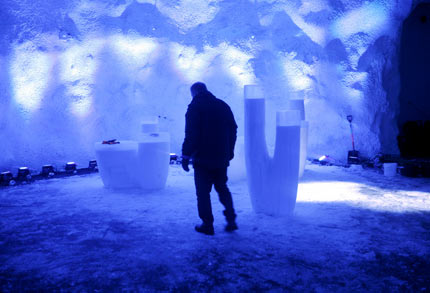
LONGYEARBYEN, Norway (Feb. 26) – A “doomsday” seed vault built to protect millions of food crops from climate change, wars and natural disasters opened Tuesday deep within an Arctic mountain in the remote Norwegian archipelago of Svalbard.
More photos and the whole story.
:Kathy sent..an interview with Dr. Nicholas Dodman
Posted: February 24, 2008 Filed under: Lotsa Lhasa Info Leave a comment
Illustration by John Herschend
An Interview with Dr. Nicholas Dodman by Claudia Kawczynska
 Kunza at FleetFire Timbers
